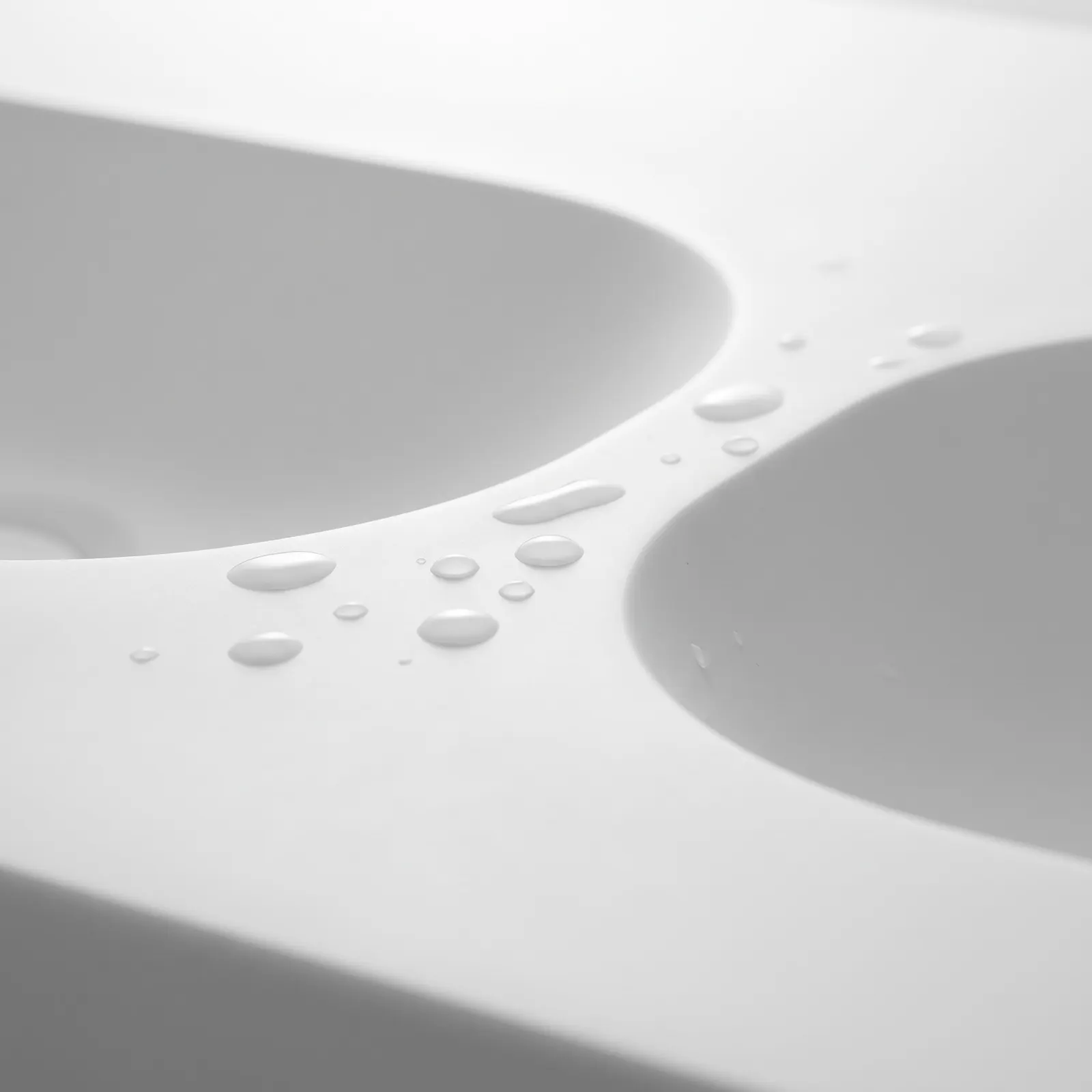
Solid surface in one paragraph
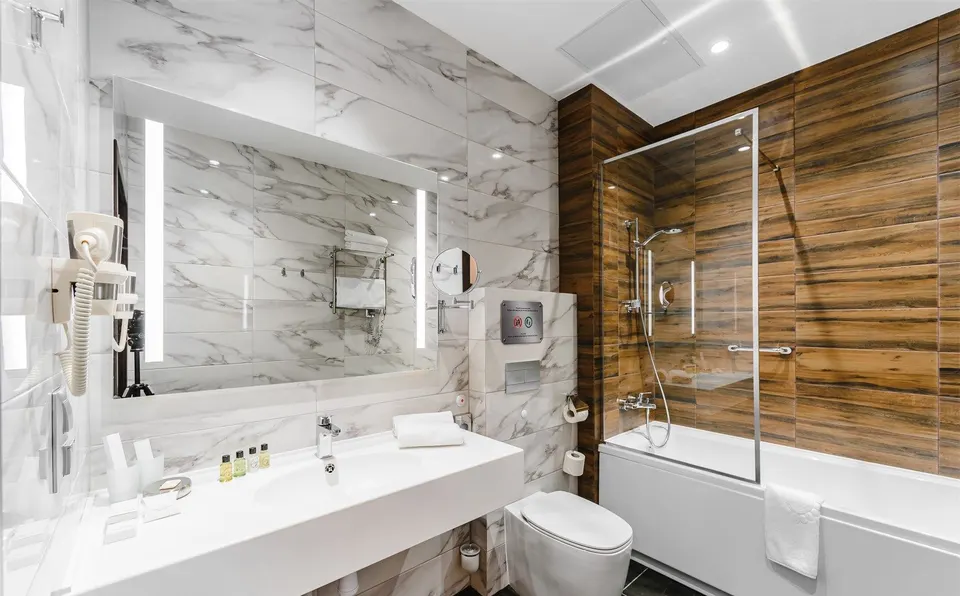
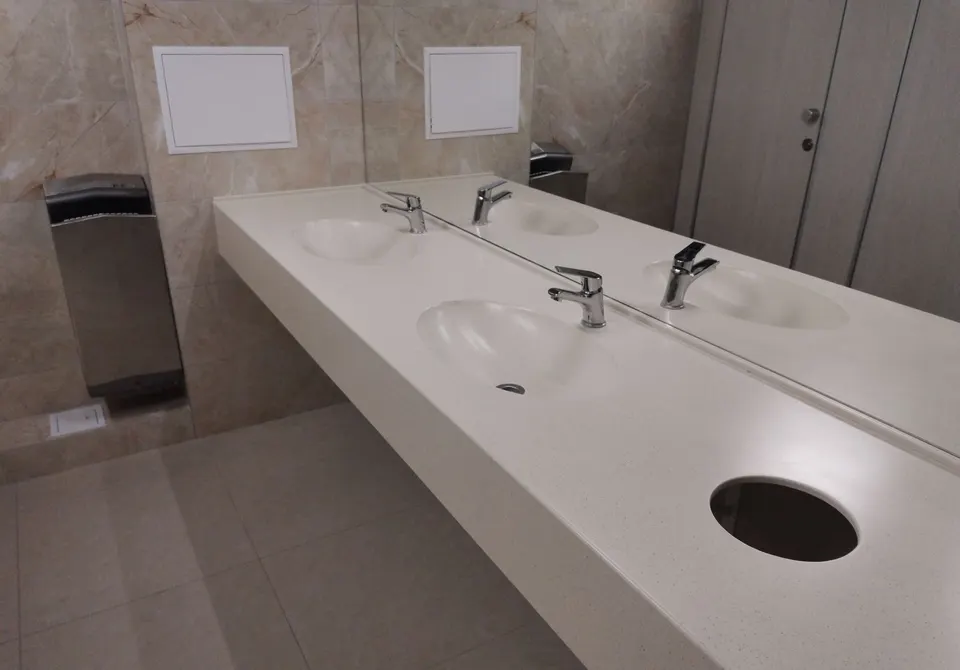
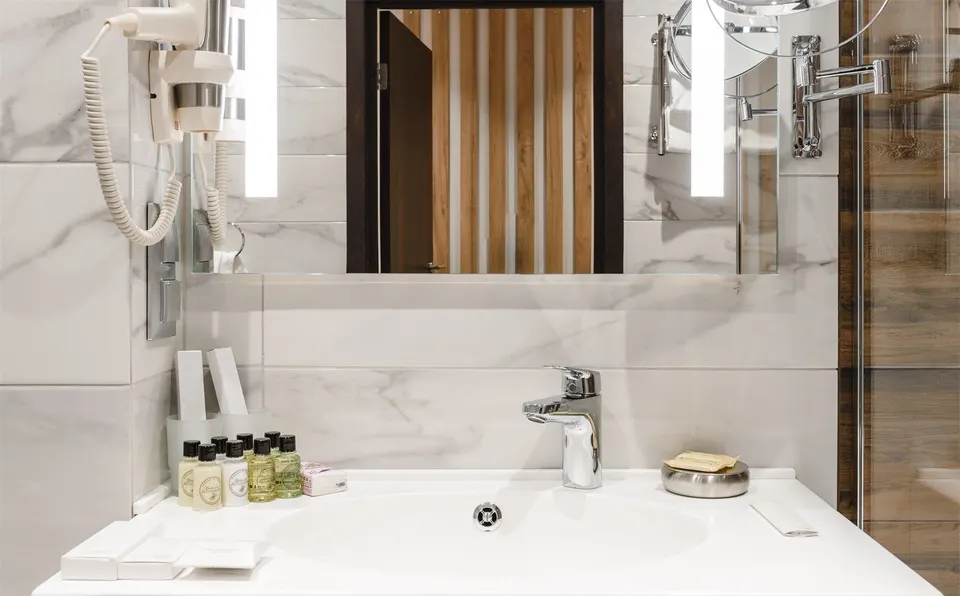
Solid surface is a sheet material made of mineral filler, resin and pigment. The colour runs through the whole thickness. It is cut and routed with woodworking tools, and the pieces are bonded with colour-matched adhesive and sanded, so the joints don’t show. Heated, a 100% acrylic sheet bends into curves. That is why it is used for vanity tops with integrated basins, wash troughs, reception counters and hospital worktops: parts that must read as one piece and be easy to keep clean.
What solid surface is made of
A typical sheet has three ingredients:
- Mineral filler, usually aluminium trihydrate (ATH). In Akrilika it is about 70% of the sheet.
- Resin, which binds the filler. This is where the grades differ.
- Pigments and particles, which give solid, particle and veined looks.
The resin decides how the material behaves in fabrication and in use.
Acrylic vs polyester solid surface
| 100% acrylic | Polyester or blended resin | |
|---|---|---|
| Thermoforming | Bends into curves and pressed basins | Limited or not recommended; check the data sheet |
| Where it is used | Curved counters, integrated basins, healthcare | Flat work, often at a lower price |
| Example | Akrilika, including the AR 2026 decors | Varies by brand |
Our Apietra collection is a modified acrylic. It costs about 20–30% less than Akrilika and is not thermoformable. We sell it under its own name so the two are never confused on a specification.
Solid surface is also not the same as cast marble (cultured marble). Cast marble is moulded to shape and finished with a gel coat. Solid surface is a homogeneous sheet, so a scratch can be sanded out without going through a coating. See solid surface vs quartz, ceramic and cast marble.
How a sheet becomes a vanity top
- Cutting. Sheets (3660 × 760 × 12 mm for Akrilika) are cut and routed with woodworking tools. The manufacturer recommends FESTOOL power tools.
- Bonding. Parts are joined with an adhesive matched to the colour code, clamped, then sanded flush. Akrilika parts are joined without visible seams and gaps.
- Thermoforming. A 100% acrylic sheet is heated and bent over a form for curved fronts and radius corners.
- Basins. Cast basins are bonded under the top with special adhesive, without silicone, so there is no gap at the rim.
- Finishing. The surface is sanded to a matte, semi-gloss or gloss finish.
Veined decors need a cutting plan, because the pattern breaks at each joint. See cut-to-size and fabrication.
Solid surface pros and cons
| Strengths | Limits |
|---|---|
| Seamless joints over long runs | Softer than quartz or ceramic, so it scratches sooner |
| Integrated basins, no silicone line at the rim | Needs trivets under hot pans; dry heat class 7A is 180 °C on Akrilika |
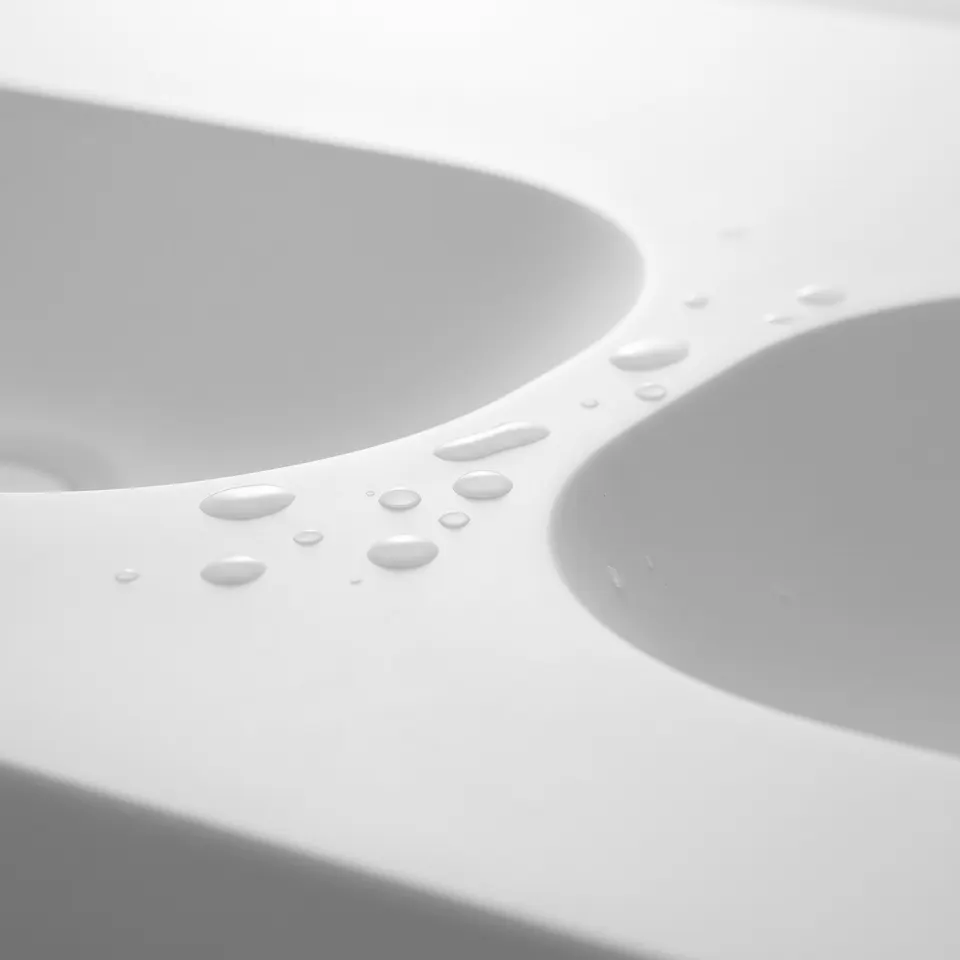
| Non-porous: 0.27% water absorption over 49 days | Dark colours show wear more and need more care |
| Scratches, chips and cracks are removed without visible traces | Not for outdoor or unheated rooms |
| Thermoformable (100% acrylic grades) | Not a floor or slip-rated surface |
Where solid surface performs best, and where to choose something else
Best: washroom vanity tops and wash troughs, basins, reception and bar counters, healthcare worktops, and wall cladding in wet rooms. In all of these, joints, cleaning and repair matter more than scratch hardness.
Consider something else:
- Heavy-wear flat worktops where scratch hardness matters most: quartz is the harder surface. See AQ Stone quartz.
- Toilet cubicles and partitions: compact laminate is often more economical. See solid surface vs compact laminate.
- Floors, facades and outdoor furniture: use materials tested for those uses.
Solid surface, Corian and other brand names
Many people say “Corian” when they mean solid surface, in the same way people say “Hoover”. Corian, HIMACS, Krion, Staron and Akrilika are brands in the same category, and each has its own composition, sheet sizes, colours and test data. If you are comparing brands for a project, read looking for a Corian alternative. For every Akrilika result, with lab and year, see technical data.