Short answer: compare the category, then the data
“Corian” has become shorthand for solid surface, much as “Hoover” became shorthand for a vacuum cleaner. When a brief says “Corian or equal”, it is asking for a solid surface that meets the same functional requirements: seamless joints, integrated basins, repairability, and the fire and hygiene data the project needs.
Corian, HIMACS, Krion, Staron and Akrilika all make materials in that category. They differ in resin system, sheet formats, colour ranges, test reports and supply routes. The useful comparison is not brand against brand. It is each brand’s data sheet against your specification.
Corian, HIMACS, Krion and Staron are trademarks of their respective owners. We use the names only to identify products that specifiers compare.
What the established brands do well
It’s fair to start here. The long-established solid surface brands have large published colour libraries, well-known distributor networks in many European countries, and a long record of use in commercial interiors. Many specifiers already have their details in their standard specifications. If your project depends on a named brand’s certification, local stock or fabricator network, that is a good reason to stay with it.
Akrilika vs Corian, HIMACS, Krion and Staron: a checklist
The left column is Akrilika’s data. For the other brands, we tell you where to look, not what they claim. Their figures change, and it is their job to publish them.
| What to check | Akrilika | For the other brand, check |
|---|---|---|
| Resin system | 100% acrylic, about 70% ATH (Apietra is a separate modified acrylic line) | Current data sheet: acrylic, modified acrylic or other |
| Sheet format | 3660 × 760 × 12 mm; 6 mm in A101 only (2440 × 760); AR 2026 on 3680 × 760 | Formats and thicknesses per colour |
| Current colours | 73 + 5 AR (2026); 52 more in Apietra | Current colour list and discontinued codes |
| Thermoforming | Yes, including pressed basins and sinks | Thermoforming guide per colour |
| Cast basins | Cast basins in A101 Glacier White, bonded without silicone | Basin range and colour options |
| Reaction to fire | Bfl-s1 to EN 13501-1 (TÜV Rheinland test report, 2015, A101); Class 1 surface spread of flame, BS 476-7 (SGS) | Classification report, the colour and substrate tested, and whether it is a wall or floor class |
| Food contact | Tested by TÜV Rheinland, 2016, to Reg. (EU) 1935/2004 and 10/2011 | Food-contact report |
| Stain and chemical resistance | ANSI Z124.3: pass (SGS, 2016) | Test standard and results |
| Warranty | 15 years limited; certified fabricator; heated indoor rooms | Warranty length and conditions |
| Supply | Factory-direct to projects across Europe | Local distributor and stock |
Everything in the Akrilika column is backed by a report or catalogue entry listed on our technical data page.
HIMACS vs Corian vs Krion: why the names get compared
Specifiers usually compare these brands for one of three reasons. The specified colour has been discontinued. The budget has moved. Or the contractor has an established supply route for another brand. In each case, the question is the same: does the alternative meet the performance clauses, and does the colour match closely enough for the client?
Colour is usually the hardest part. No two brands’ whites are identical. Sample against the specified colour under the project’s lighting before anyone signs a substitution.
Swapping to Akrilika on a live project
- Send the specification clause, the colour, the thickness, the basin models and the quantities.
- We propose the closest Akrilika code and send samples for side-by-side approval.
- We map the evidence to each clause (fire, food contact, stains and so on) and tell you plainly where we can’t match a requirement.
- The architect or client approves the substitution. We then confirm lead time and batch with the quote.
Our specification support team can also write the clause for a new project, so it names Akrilika with an “or equal” route.
Where Akrilika fits, and where it may not
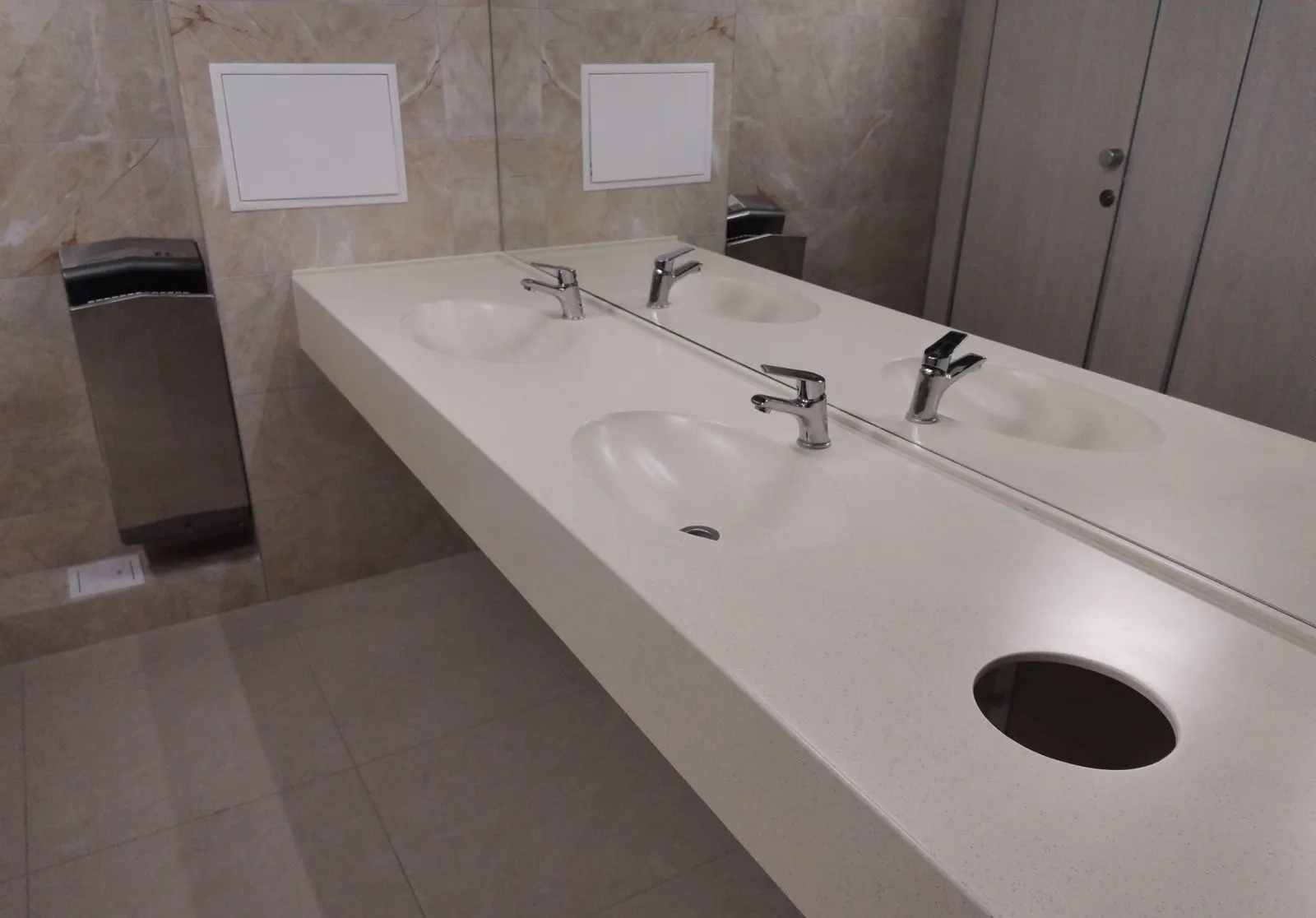
A strong fit: washroom vanity tops and wash troughs, healthcare worktops, hotel bathrooms and counters, and OEM series, where seamless joints, thermoforming and factory-direct supply matter.
Check first: if a tender asks for marine or rail approvals, a CE declaration, an NSF listing or a specific eco-label, ask us for the report before you commit. We would rather tell you at the start than at approval stage.