Good solid surface specification is mostly about the conditions around the code: who fabricates it, where it is installed, how the joints are made and which batch the sheets come from. Get those wrong and the warranty or the finish fails, however good the colour looked on the moodboard. We help architects and interior designers write those conditions correctly, from the first sample to the tender package.
What we provide for solid surface specification
- Technical data. Physical, fire, stain, chemical and heat-resistance results with the standard, lab and year for each. See technical data.
- Test reports on request. The TÜV Rheinland (2015–2016) and SGS (2016) reports behind the data, for your project file.
- Samples. Colour samples in 100 × 70 mm, and a larger 1220 × 380 mm format where you need to judge a vein or a large surface. Order samples.
- Colour and edge advice. Which colours suit heavy use, which decors show joints, and which edge profiles work at 12 mm.
- Drawing review. Send your details and we check them against the sheet sizes, thermoforming limits and joint positions before tender.
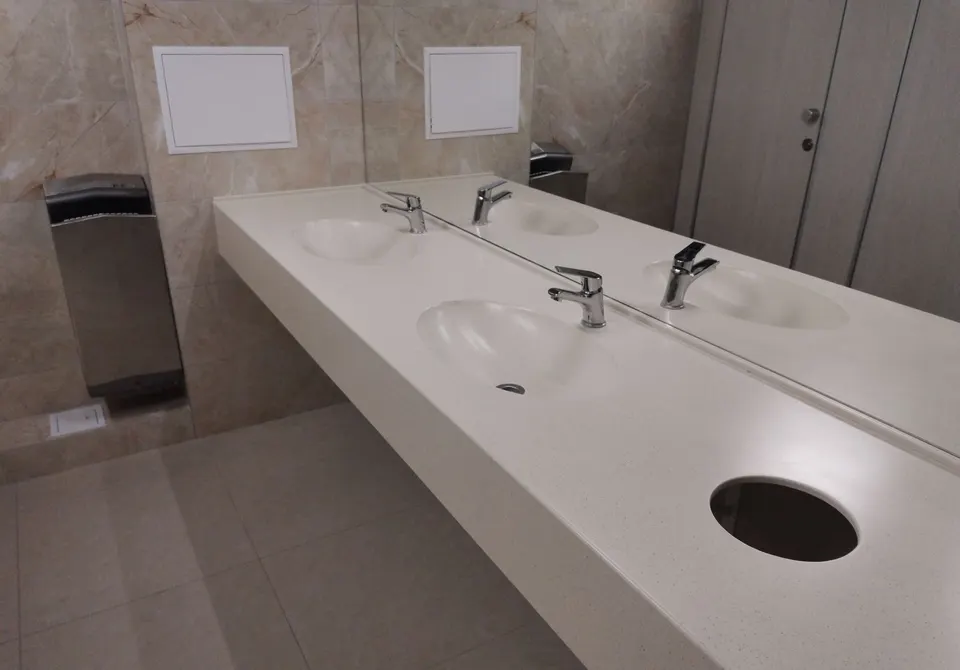
We don’t offer BIM objects or a DWG library. Model drawings for cast basins and fabricated sinks are available on request.
Solid surface for architects: points that trip up specifications
Collection versus shape. Akrilika and the AR colours are 100% acrylic and can be thermoformed. Apietra is a modified acrylic and cannot be bent. A curved desk or an integrated radius basin drawn in an Apietra code cannot be built. We check this on every drawing.
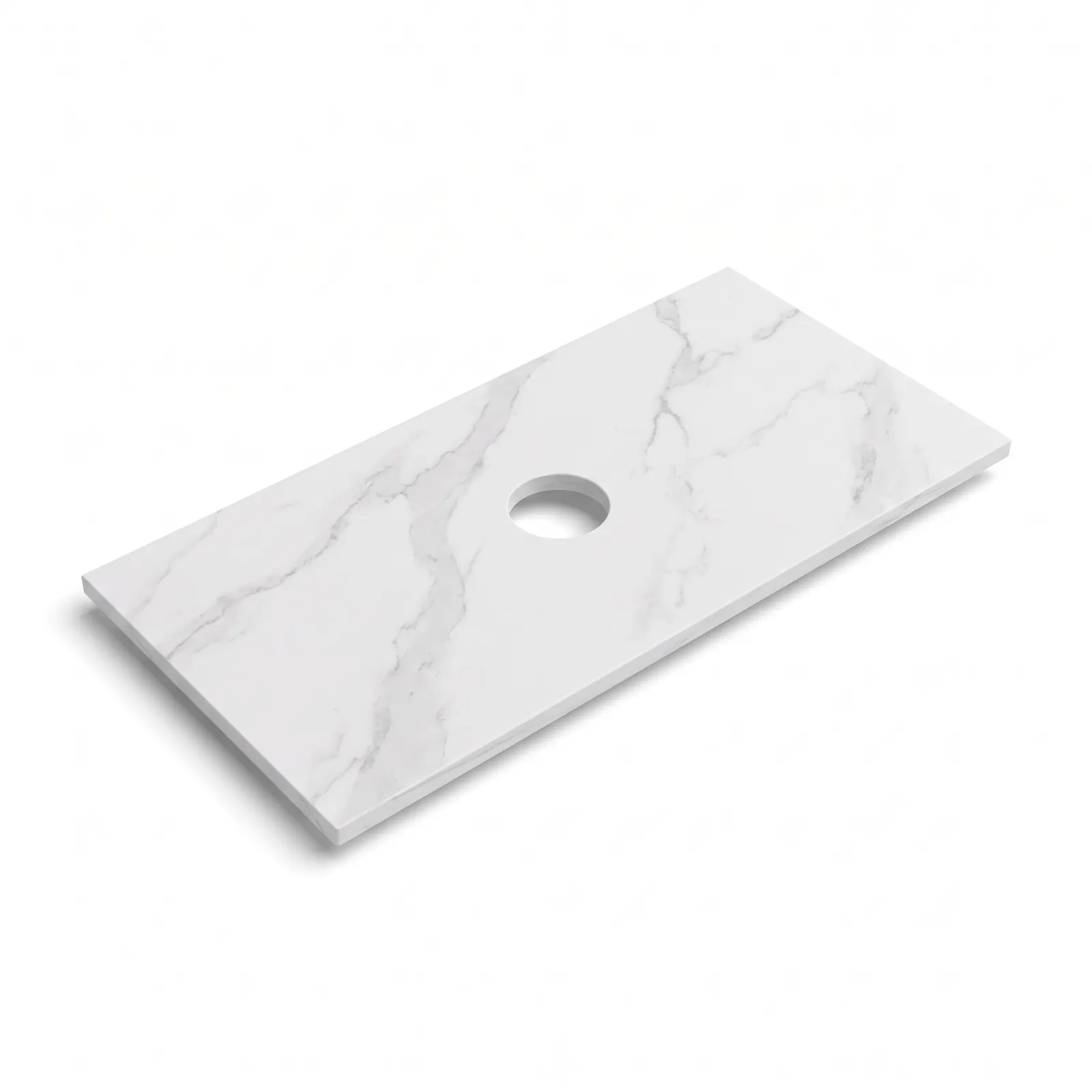
Sheet size. Sheets are 3660 × 760 mm (3680 mm for AR and some veined Apietra decors). Anything longer or deeper has a bonded joint. With veined decors the pattern breaks at every joint, so show joint positions on the elevation.
Batch. The warranty terms state that colour can vary between and within batches. For hotels, offices and any repeated unit, require all sheets for the series to be ordered together, from one batch.
Dark shades. The catalogue does not recommend dark colours for worktops in heavy daily use.
Light. In TÜV Rheinland lightfastness testing, A101 and A507 passed, but A906 did not meet the requirement. Where a surface faces strong daylight, ask us what data exists for your colour.
Chemical resistance. Furniture-surface grades to DIN 68861-1 vary by colour. For washrooms and labs, cite the ANSI Z124.3 results, which Akrilika passed for ethanol, ammonia, citric acid, 3% hydrogen peroxide and concentrated hypochlorite.
Fire and hygiene wording you can use
- Fire: “Bfl-s1 to EN 13501-1 (TÜV Rheinland test report, 2015, A101)” and “Class 1 surface spread of flame, BS 476-7 (SGS)”. We quote no other fire class.
- Hygiene: “non-porous surface; the manufacturer states it does not support microbial growth when cleaned properly”.
- Food contact: Akrilika passed TÜV Rheinland sensory and migration testing referenced to EU food-contact regulations (2016, colours tested). Ask for the report if your project needs it.
Warranty conditions to carry into the specification
Akrilika carries a limited 15-year warranty and Apietra a limited 10-year warranty. Both depend on:
- fabrication by a firm holding the Akrilika training certificate;
- installation indoors, in heated rooms.
Appearance claims are not accepted after a sheet has been cut, so build a colour and pattern approval step into the programme before fabrication.
Write these into the specification, not only the contract, so the contractor prices a certified fabricator from the start.
How a review works
Send drawings, the room schedule and the codes you are considering to hello@akrilika.eu. We reply with comments marked against the drawing: joint positions, thermoforming conflicts, edge build-ups, basin models and anything that affects the warranty. If a colour is still open, we suggest two or three that suit the use and send samples.