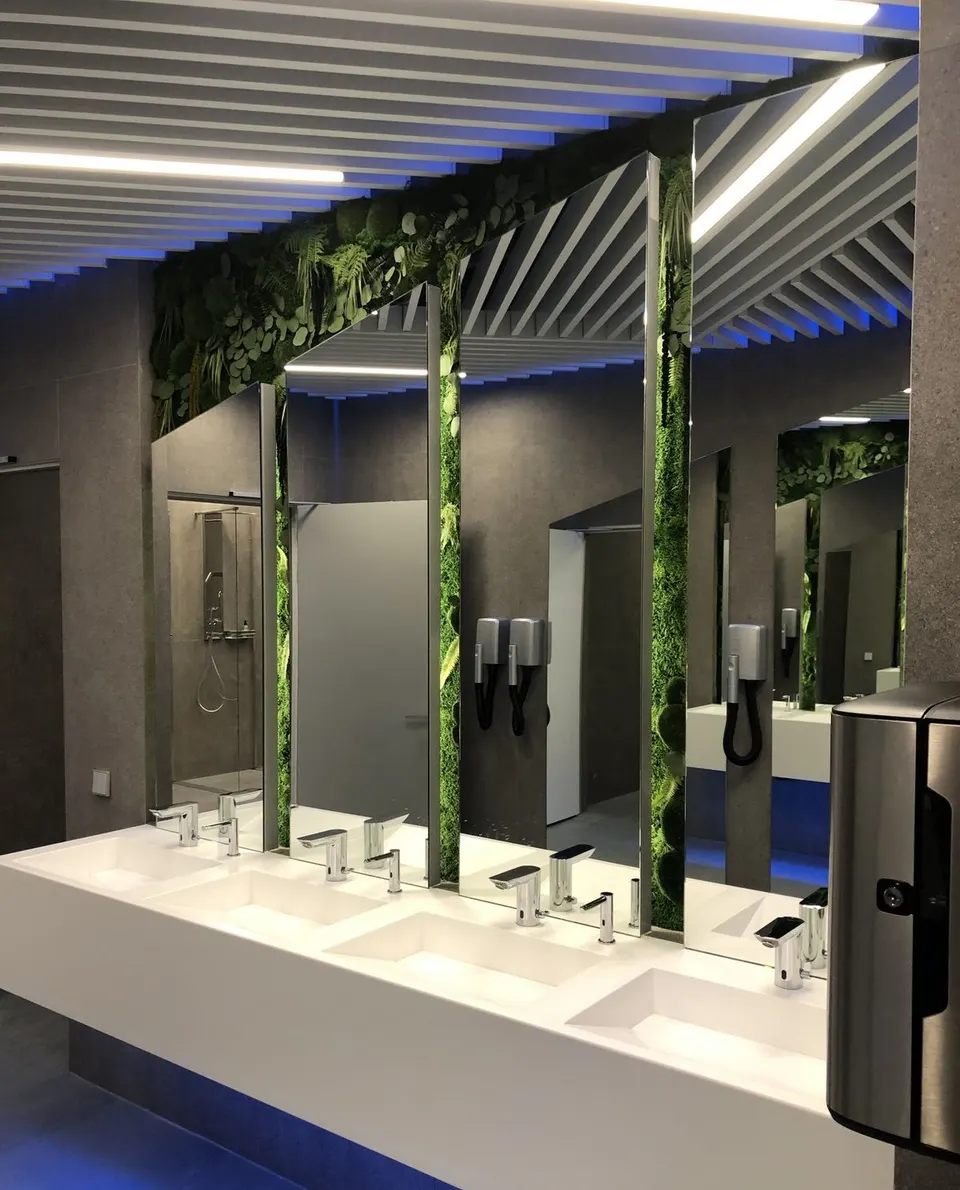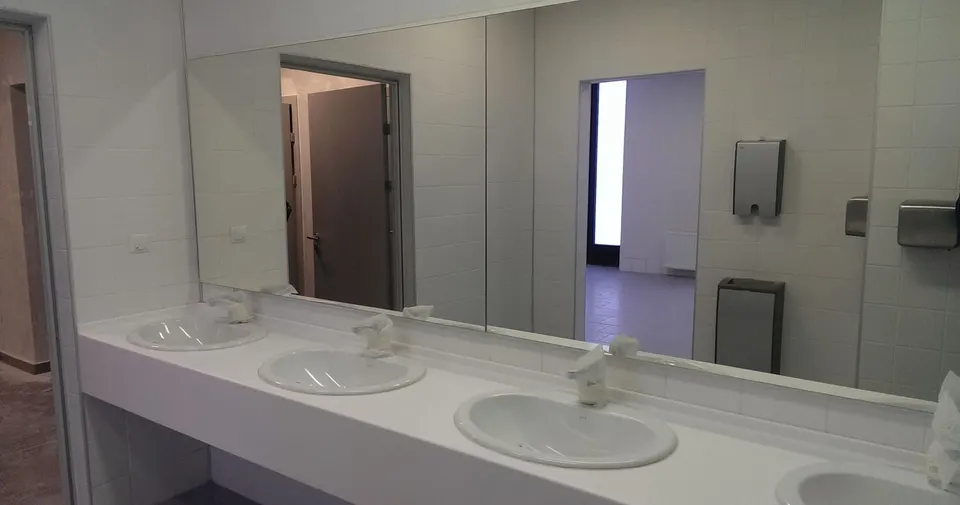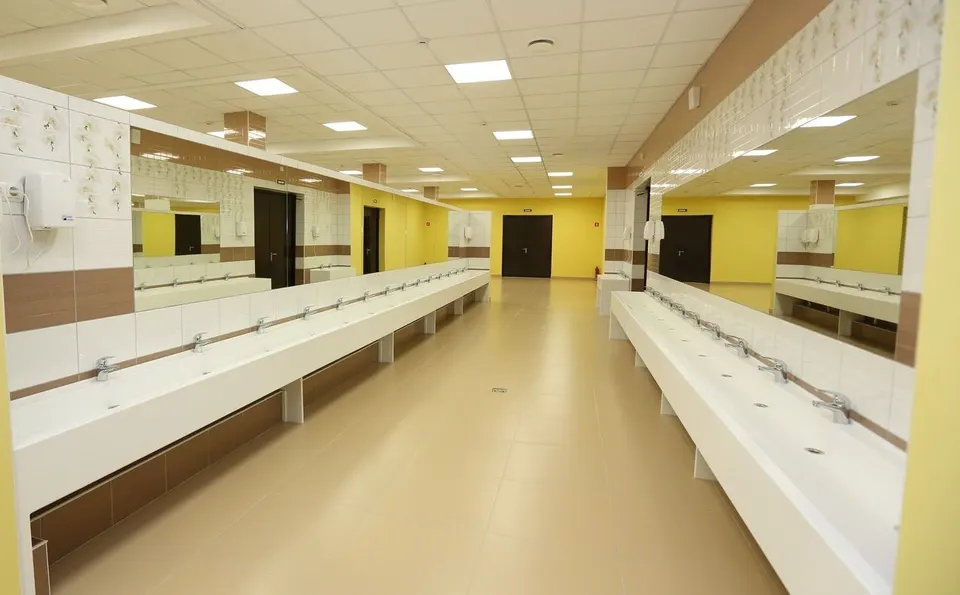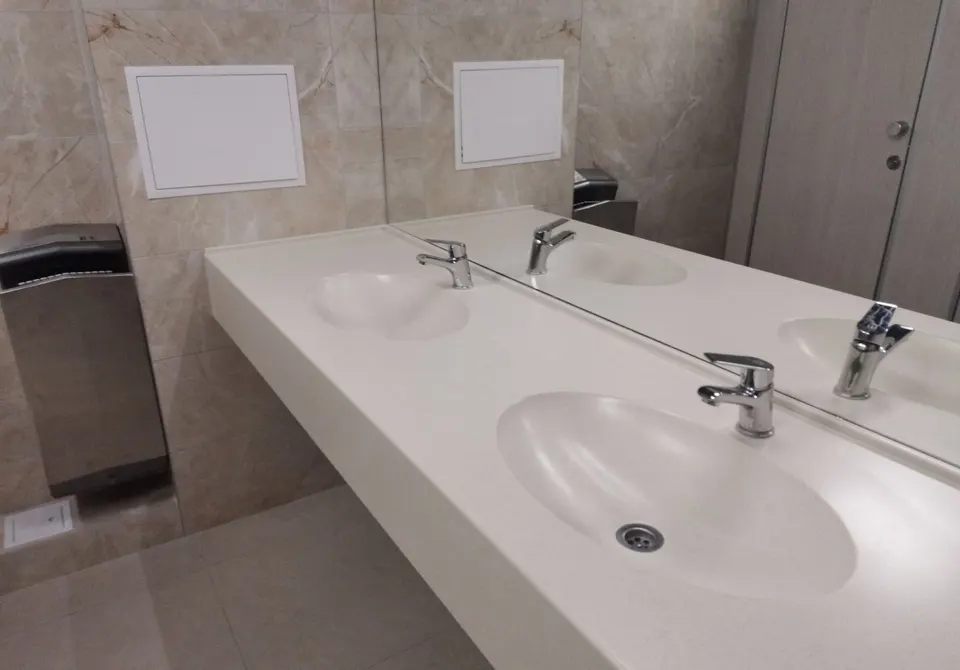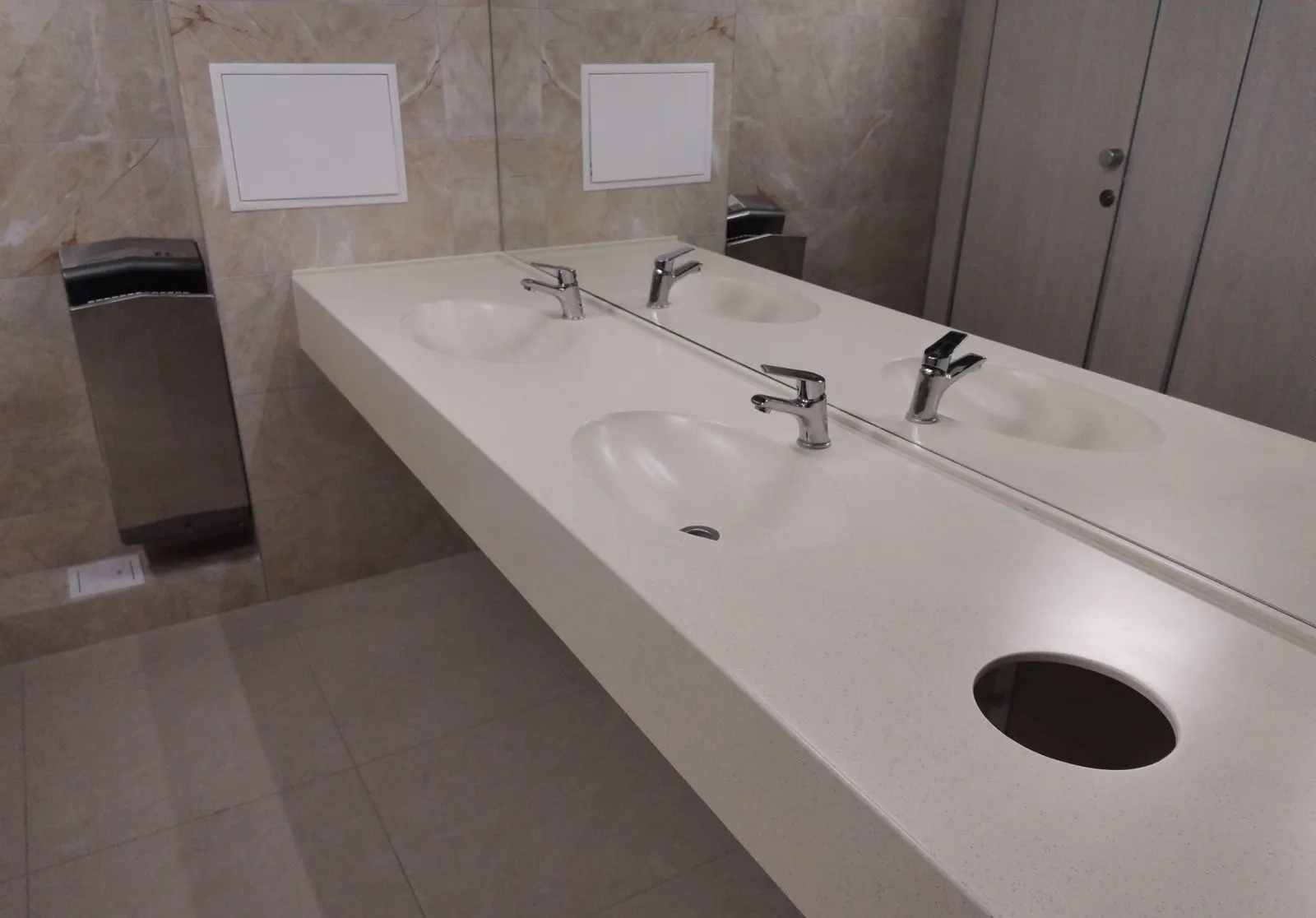
Commercial washroom surfaces take more abuse than any other surface in a building: hundreds of users a day, cleaning every few hours, and the odd deliberate act of damage. Solid surface handles that because the colour runs through the full thickness and parts are bonded with seamless joints. When something goes wrong, the top is sanded back in place instead of replaced. This page is for washroom contractors, architects and facility teams in schools, transport hubs, offices and leisure buildings.
Why commercial washroom surfaces fail, and what solid surface changes
Most washroom failures follow one of three patterns:
- Water gets into an edge or joint. Board edges swell, and silicone turns black. Solid surface is non-porous (0.27% water absorption after 49 days), and basins are bonded under the top without silicone.
- A chip or burn makes the top look finished. With solid surface it is sanded and polished out on site.
- Ceramic basins crack and have to be replaced one by one. An integrated basin is part of the top and is repaired the same way.
Wash troughs for schools, stations and leisure buildings
A wash trough serves several users from one continuous bowl, with no gaps between basins for dirt to collect. It is the standard answer for school washrooms, sports changing rooms, stadiums and the busiest washrooms in transport hubs.
For each trough, we need:
- The overall length and number of user positions. One sheet is 3660 mm. Anything longer is bonded from several pieces with colour-matched adhesive.
- The tap and waste positions, including whether taps are deck- or wall-mounted.
- The rim height. Schools and nurseries often need a lower trough for younger children, or two heights in one room.
- The upstand and apron heights, and how the trough is supported (brackets, frame or furniture).
Multi-basin vanity tops with cast or fabricated bowls
Office buildings and airport washrooms usually use a continuous vanity top with individual bowls bonded underneath. Cast basins in A101 Glacier White come in fixed sizes (internal dimensions):
| Model | Internal size (mm) | Module | Notes |
|---|---|---|---|
| m281 | 375 × 270 × 140 | 50 | built-in overflow |
| m283 | 415 × 330 × 140 | 50 | |
| m285L | 460 × 365 × 155 | 60 | |
| m286 | 460 × 325 × 130 | 60 | built-in overflow |
| m283L | 500 × 340 × 155 | 70 |
For coloured tops, basins can be fabricated from sheet in any colour. See vanity tops and basins.
Repairable in situ: what that means on site
The strongest argument for solid surface in a public washroom is what happens in year three:
- Scratches and marker pen are sanded and polished out. In ANSI Z124.3 testing, ink, crayon and shoe polish stained no deeper than 0.111 mm, against a limit of 0.127 mm.
- Cigarette burns pass the ANSI Z124.3 burn test, and any mark left is removed by sanding.
- Chips and cracks are repaired by a certified Akrilika fabricator without removing the top.
Repairs are a paid service. They are not covered by the warranty, which excludes mechanical damage and normal wear.
Accessible basins: design guidance only
We do not sell a dedicated accessible basin. Solid surface tops can be made to any height and depth your drawings show, including knee clearance under the bowl and a shallow bowl depth at accessible positions. Compliance depends on the whole installation: heights, reach to the taps, grab rails and clear floor space. Check your national regulation, for example UK Approved Document M, DIN 18040-1 in Germany or EN 17210, and design to it.
Supplying washroom contractors
Washroom contractors can buy full sheets for their own workshop, or fabricated tops and troughs made to their drawings. Adhesive is colour-matched to each colour code. Warranty cover requires fabrication by a firm holding the Akrilika training certificate. Lead times are confirmed with each quote.
What not to use it for
Do not use solid surface for washroom floors or shower floors, because it has no slip-resistance class. Do not use it in unheated or outdoor toilet blocks, because the warranty excludes both. For fire, the TÜV classification is Bfl-s1 to EN 13501-1, which is a flooring class. Check what your building’s fire strategy requires for wall-mounted parts. The washroom specification guide walks through the full checklist.