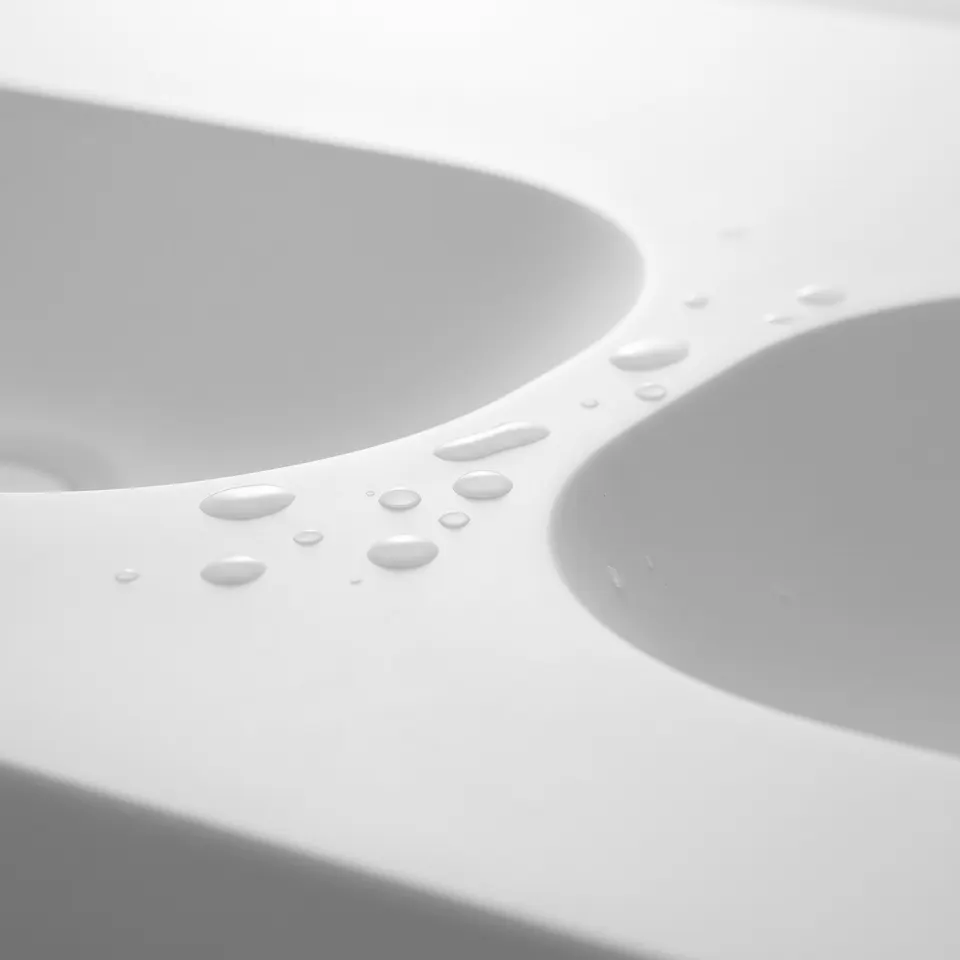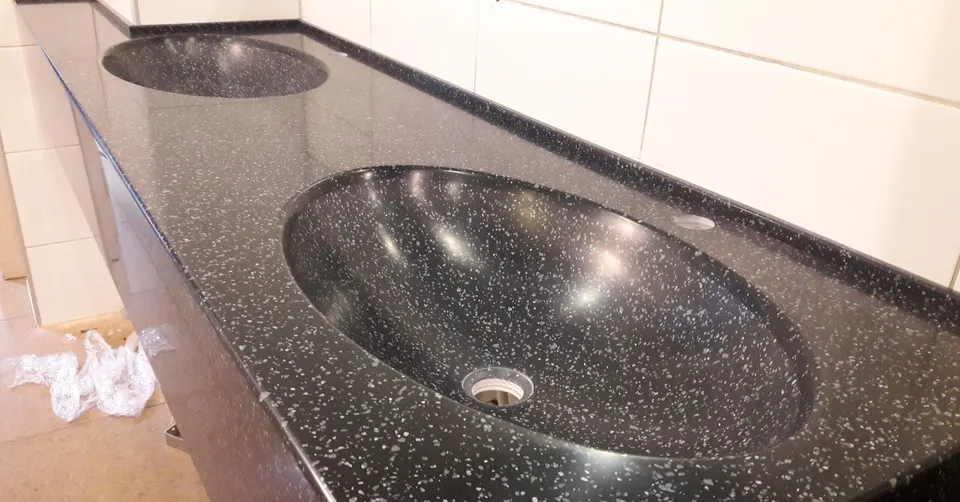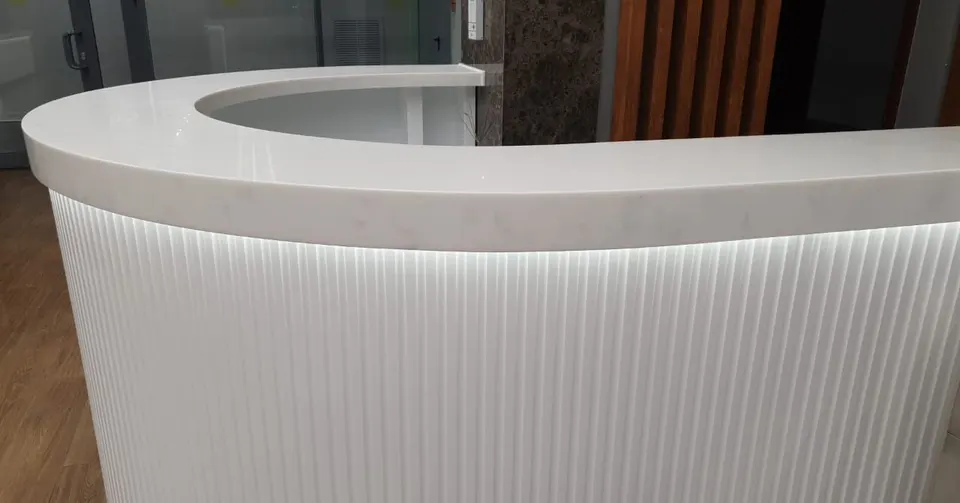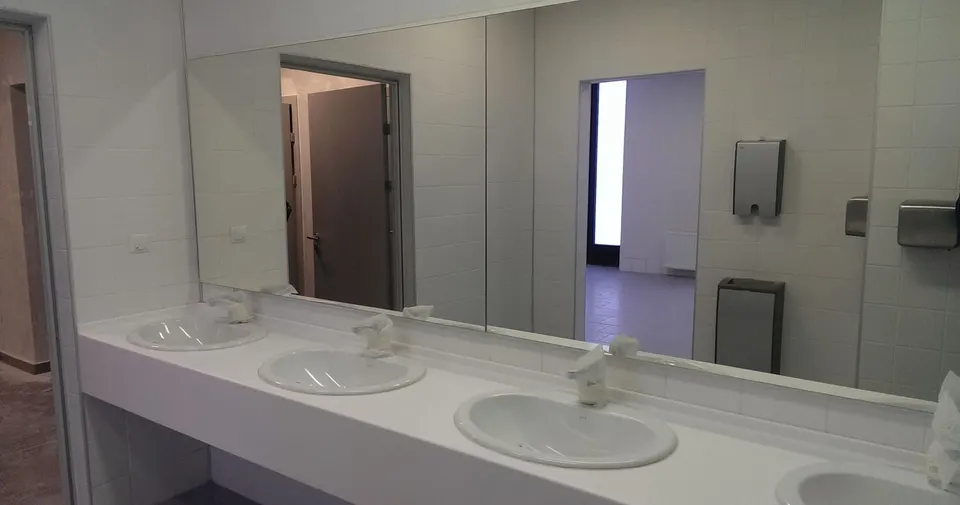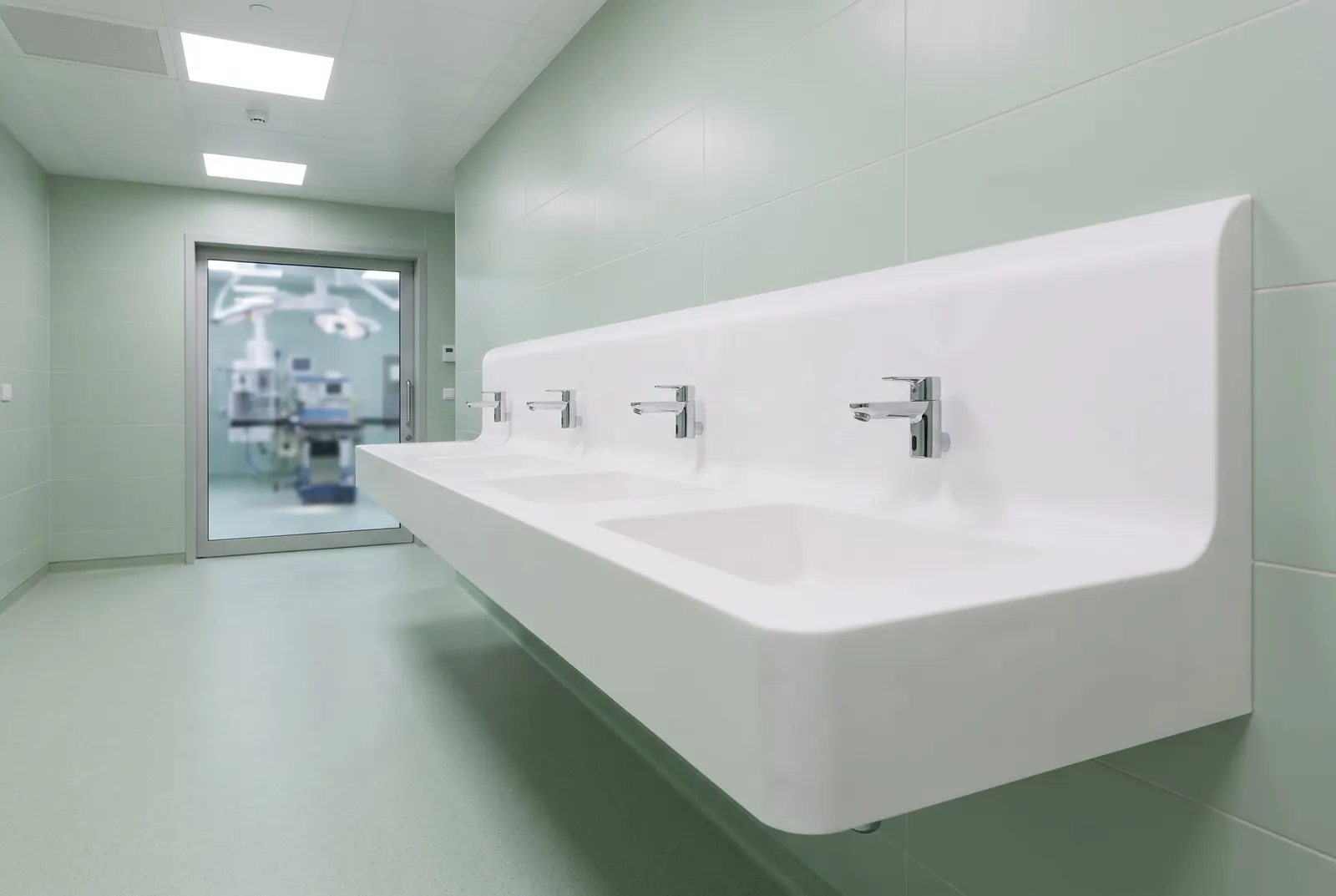
Solid surface in healthcare is chosen for three reasons you can check: the surface is non-porous, parts are joined with seamless joints instead of grout or silicone, and damage is repaired in place. Akrilika is a 100% acrylic solid surface with the colour through its full thickness. This page covers where it fits in hospitals, clinics, dental surgeries, laboratories and care homes, with the test results that back each point and the claims we will not make.
What a hygienic surface means here, and what we do not claim
Hygienic surfaces in hospitals are judged on how easy they are to clean, not on slogans. Akrilika gives you:
- No pores. Water absorption is 0.27% after 49 days’ immersion (ASTM D570).
- No open joints. Tops, upstands and basins are bonded with colour-matched adhesive, and sinks are fitted without silicone, with no gap between top and bowl.
- Coved details. Upstands can be coved into the worktop, so there is no internal corner for dirt to sit in.
What we do not claim: “antibacterial”, “antimicrobial” or “infection-control certified”. No antimicrobial test such as ISO 22196 is on file. The manufacturer states that the surface does not support microbial growth when cleaned properly. That is a manufacturer statement, and we present it as one.
Chemical and stain resistance: the ANSI Z124.3 results
Clinical surfaces meet iodine, gentian violet and strong disinfectants every day. SGS tested Akrilika to ANSI Z124.3-2005:
| Agent | Result |
|---|---|
| Iodine, gentian violet, ink, crayon, shoe polish, lipstick, hair dye | Pass; max. stain depth 0–0.111 mm (limit 0.127 mm) |
| Concentrated sodium hypochlorite | Pass |
| Hydrogen peroxide 3 % | Pass |
| Ethanol, ammonia 10 %, citric acid 10 %, urea, naphtha | Pass |
| Amyl acetate | Superficial surface change |
TÜV Rheinland also tested to ISO 19712-2 (grade 5 = no change): hydrogen peroxide 30% scored 5, sodium hydroxide 25% scored 5, and acetone scored 3. Furniture-surface grades to DIN 68861-1 vary by colour, so check the colour you specify on the technical data page.
Where it goes: hospitals, clinics, labs and care homes
- Nurse stations and reception desks. Long counters with no visible joints, curved fronts in Akrilika (thermoformable), and inset equipment.
- Hospital worktops in treatment, sterilisation and utility rooms, with integrated sinks and coved upstands.
- Laboratory worktops where the chemicals match the list above. For solvent-heavy benches, test first.
- Dental surgery surfaces: cabinetry tops and integrated basins.
- Patient-room vanity tops and care home washrooms, with basins bonded underneath.
- Window boards, bedside tops and wall-mounted shelves, cut from the same sheet so the colour matches.
For tops close to food, TÜV Rheinland food-contact testing (2016) covered migration to Regulation (EU) 10/2011 and passed.
Clinical basins: on request
The manufacturer’s medical basin series includes patient-room, dental, nurse-station and scrub-sink models with fully coved construction. EU availability is confirmed per project, so we list it as on request, not as stock. We make no claims about HTM, DIN or ADA compliance. Tell us which room types you are planning and we will confirm what can be supplied. Standard cast basins in A101 Glacier White are listed on the basins page.
Repair in place, fewer closures
Every clinical surface gets scratched in the end. The colour runs through the full thickness, so scratches, chips and cracks are sanded and polished out where the top is installed. The work is done by a certified Akrilika fabricator as a paid service. Compared with replacing a laminate or ceramic top, the room is out of use for a shorter time and the top stays in place.
Cleaning regime and colour choice
Daily cleaning is a soft sponge with a standard cleaner. Heavy soiling is treated according to the finish (matte, semi-gloss or gloss). The care and repair guide sets out the method for each. The manufacturer notes that dark shades are not recommended for worktops in intensive use, and need more care. For clinical worktops, a light solid colour is the safer choice.
Fire and documentation
Reaction to fire is Bfl-s1 to EN 13501-1 (TÜV Rheinland, 2015, A101 on fibre-cement), which is a flooring class. SGS tested Class 1 surface spread of flame to BS 476-7. There is no wall or ceiling Euroclass on file, so raise it early if your fire strategy needs one. Test reports are listed in downloads.
Warranty conditions
Akrilika carries a 15-year limited warranty in heated indoor rooms when the parts are fabricated by a firm with the Akrilika training certificate. Normal wear, scratches and stains are excluded, and they are handled by repair. Request samples to test your own disinfectants on the colour you plan to use.